
Hernia Surgeon in Ahmedabad — Laparoscopic and Open Hernia Repair

Ahmedabad and Gandhinagar · Dr. Jivraj Mehta Hospital, Vasna, Ahmedabad

Tapping Book on WhatsApp will likely open the WhatsApp app on your phone.

You have a bulge in the groin, near the navel, or in an old scar. It may ache at the end of the day. It may go back in when you lie down. You want to know what it is, whether it needs an operation, and who should do it. This page is the starting point. It covers every kind of hernia that Dr Harsh Shah repairs, the two ways it can be done, and what the whole process looks like from the first visit to full recovery.

In short: Dr Harsh Shah repairs all adult abdominal wall and groin hernias in Ahmedabad, by laparoscopic or open surgery, chosen for each patient after examination.

Last updated: 18 October 2026

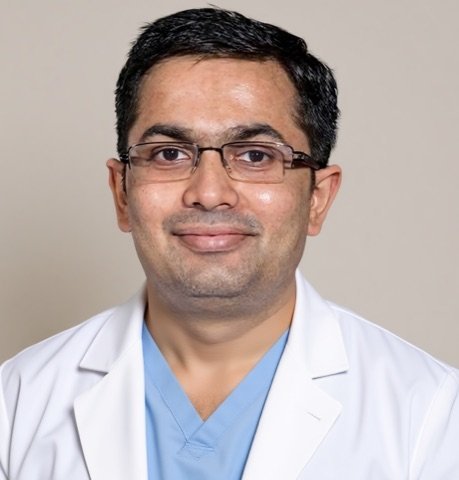
Dr Harsh Shah · hernia repair at Dr. Jivraj Mehta Hospital, Vasna, Ahmedabad. He trained in surgery at Maulana Azad Medical College and in surgical gastroenterology at GB Pant Hospital, Delhi. He has 18 years of experience. He repairs groin, navel, scar and diaphragm hernias. Each operation note records the defect size, the layer used and the mesh placed. So anyone who examines you years later knows exactly what was done.
Call +91 63555 64601 WhatsApp your scan or doctor’s note

What a hernia is, in plain words

A hernia is a weak spot or gap in the muscle wall of the abdomen. Fat or a loop of bowel pushes through it and shows as a bulge.

The wall of your abdomen is made of layers of muscle and tough tissue. Some places in that wall are weak by nature. The groin is one. The navel is another. An old operation scar can become a third. When pressure inside the abdomen pushes on a weak spot, the lining bulges out through it. That bulge is a hernia.

Most hernias start small. Many grow over months or years. A hernia does not heal by itself, because the gap is in the muscle, not in the skin. A belt or a binder can hold it in for a while. It does not close the gap. Medicines do not close it either. When a hernia needs treatment, the treatment is an operation.

Not every hernia needs an operation straight away. Some small ones that cause no trouble can be watched. Others should be repaired soon. The type of hernia, where it is, and what it is doing to you decide which.

Which hernia do you have? Every type Dr Harsh Shah repairs

The place of the bulge names the hernia: groin, navel, above the navel, an old scar, the side wall, around a stoma, or the diaphragm.

Find your type in the table below. Each name links to a full page about that hernia and its repair.

HerniaWhere you feel itUsual repair
Inguinal herniaGroin, sometimes into the scrotumLaparoscopic TEP or TAPP; open in some cases
Hernia on both sidesBoth groinsLaparoscopic, both sides through the same small cuts
Femoral herniaUpper thigh, just below the groin creaseRepaired soon; laparoscopic or open
Umbilical herniaIn or around the navelOpen for small ones; laparoscopic for larger ones
Epigastric herniaThe midline above the navelOpen or laparoscopic, by size
Diastasis rectiA ridge down the middle, often after pregnancyRepair only when it causes symptoms
Ventral and incisional herniaFront of the abdomen or an old scarLaparoscopic IPOM or eTEP; open sublay
Complex and recurrent herniaA hernia that came back, or a very large onePlanned from a CT scan; laparoscopic or open
Spigelian herniaSide of the lower abdomenLaparoscopic in most cases
Parastomal herniaAround a stomaLaparoscopic or open mesh repair
Lumbar herniaThe back of the flank, near the lower ribsLaparoscopic or open mesh repair
Hiatal herniaNot felt; causes reflux, heartburn or food stickingLaparoscopic repair with a wrap
Open hernia repairAny site, when open suits you betterOpen mesh repair, often under spinal anaesthesia

Not sure which one you have? That is normal. Many people are not. The diagnosis is made by examining you, standing and lying down. A scan is added only when it is needed.

Laparoscopic or open: how the approach is chosen

Both work well. The choice depends on the hernia type and size, any past surgery, your health, and the type of anaesthesia that suits you.

There are two ways to repair a hernia. In laparoscopic surgery, the surgeon works through three small cuts with a camera and fine instruments. The mesh is placed from inside or behind the muscle. In open surgery, there is one cut over the hernia. The surgeon repairs it directly and places the mesh in the right layer.

Neither is right for everyone. Dr Harsh Shah does both, so the choice can follow the hernia and not the surgeon’s habit. This table shows how the two compare in general.

PointLaparoscopic repairOpen repair
CutsThree small cuts, 5 to 10 mmOne cut over the hernia
AnaesthesiaGeneral anaesthesiaOften spinal or local; general for large repairs
Hernia on both sidesBoth done through the same cutsNeeds a cut on each side
Hernia back after an open repairWorks in fresh, unscarred tissueHas to go back through old scar
Pain in the first weeksUsually lessUsually a little more
Return to desk workOften within a weekOften one to two weeks
When it may not suitHeart or lung disease that makes general anaesthesia risky; heavy scarring insideVery large defects in a heavy patient where wound problems are more likely

Both use a mesh in almost every adult repair. A repair with stitches alone comes back more often. The mesh is a flat sheet of soft surgical material. Your own tissue grows into it over about six weeks. The layer where it sits matters more than the brand. There is a short note on which mesh is used in hernia repair.

Does every hernia need surgery?

No. A small groin hernia with no symptoms can often be watched. A femoral hernia, a painful hernia, or one that will not go back should be repaired.

When watching is reasonable. A small groin hernia that you barely notice, in a man who has it checked, can be watched. The risk of a sudden emergency is low in this group. Many of these people choose surgery later, when the bulge grows or starts to ache. Waiting does not make that later operation harder. Watching means regular review and knowing the warning signs. It does not mean ignoring it.

When repair is advised. A femoral hernia is repaired soon, because it is more likely to trap bowel. A hernia that hurts, grows, or limits work or walking is repaired. So is a hernia in a woman’s groin, as many of these turn out to be femoral. A navel hernia that is getting bigger is repaired before it becomes harder to fix.

What to fix first. A hernia is a weak wall under strain. Constipation, a long cough, straining to pass urine, and smoking all strain a new repair. These are treated first when possible. Stopping smoking before surgery is part of the plan. See the note on smoking and hernia surgery.

Warning signs: when a hernia is an emergency

A hernia that turns hard, painful and will not go back, with vomiting or a swollen belly, may have trapped bowel. Go to hospital the same day.
  • The bulge is hard, tender and will not go back in.
  • Pain is getting worse over hours.
  • You are vomiting, or your belly is swollen.
  • You cannot pass wind or open your bowels.
  • The skin over the bulge turns red or dark.

These signs can mean the blood supply to the trapped bowel is cut off. That needs surgery within hours. Go to the nearest hospital emergency department at once. More detail is in warning signs of a strangulated hernia.

What patients say

Your patient journey — five steps

  1. Book your consultation. Call or send a WhatsApp message to book a visit at Dr. Jivraj Mehta Hospital, Vasna. Bring any scan, your medicine list and old operation notes. Tell the doctor when the bulge shows, whether it goes back, and what it stops you doing.
  2. Tests and treatment plan. Most groin and navel hernias need no scan. An ultrasound or CT is asked for when the examination is unclear, when there is an old repair, or when the hernia is large. Blood tests and a heart check are done for anaesthesia. You leave knowing the approach, the mesh plan and the expected stay.
  3. The surgery. At Dr. Jivraj Mehta Hospital, Vasna, Ahmedabad. Laparoscopic or open, as planned. Most groin and small navel repairs take about an hour.
  4. Short hospital stay. Many groin hernia repairs go home the same day or the next morning. Larger scar and complex repairs may need two to four days. You walk on the day of surgery.
  5. Follow-up and full healing. A wound check at about one week and a review at about six weeks. Desk work often within a week. Heavy lifting is built up from about six weeks, once the mesh has grown in.

Cost, insurance and admission

The cost depends on the hernia type, the approach, the mesh, the length of stay and your room type. You get a written estimate after the consultation.

No fixed price is quoted on this page, because two hernias are rarely the same. These are the things that move the estimate:

  • The type and size of the hernia, and whether one or both sides need repair.
  • Laparoscopic or open surgery, and the anaesthesia used.
  • The size and type of mesh, and whether fixation is needed.
  • The number of nights in hospital and the room category.
  • Other health conditions that need extra tests or care.

Hernia repair is covered by most health insurance policies. Dr. Jivraj Mehta Hospital, Vasna, Ahmedabad has cashless tie-ups with most insurers and TPAs. Our coordinator sends the pre-authorisation with your examination findings and any scan. You are told what is approved before you are admitted. Bring your insurance card, a photo ID, and your policy papers. For more, see hernia surgery cost in Ahmedabad.

Recovery and the honest risks

Most people walk the same day and return to desk work within one to two weeks. Bruising, fluid swelling and short-term soreness are common and settle.

The usual course. Soreness when you get up or cough for the first few days. Bruising that appears on day two or three and fades over two weeks. A soft swelling where the hernia was, called a seroma. It is fluid and usually goes away in a few weeks without a needle.

Less common problems. Wound infection. Bleeding. Difficulty passing urine for a day after a groin repair. Injury to bowel or bladder, which is rare and is repaired at the same time. Gas pain in the shoulder for a day after laparoscopic surgery.

Long-term pain and recurrence. A small number of people have aching in the groin or scar that lasts months. Careful mesh placement away from nerves lowers this risk. A hernia can come back after any repair. A mesh that is too small, a mesh that moved, an infection, smoking and heavy lifting too soon are the usual causes. If it does come back, it can be repaired again. See what each week of recovery looks like.

Questions patients ask

Who is a hernia surgeon near me in Ahmedabad?

Dr Harsh Shah, MS, MCh (Surgical Gastroenterology), DrNB (Surgical Gastroenterology), sees patients and operates at Dr. Jivraj Mehta Hospital, Vasna, Ahmedabad. He has 18 years of experience and repairs all adult hernia types by laparoscopic or open surgery.

Can a hernia go away without an operation?

No. The gap is in the muscle and does not close by itself. A belt or binder can hold the bulge in, but it does not repair it. A small hernia with no symptoms can be watched, with regular checks. See whether medicine can treat a hernia.

Is laparoscopic hernia surgery better than open surgery?

Not for everyone. Laparoscopic repair suits hernias on both sides and hernias that came back after an open repair, and pain is often less in the first weeks. Open repair suits people who should avoid general anaesthesia and some large or scarred hernias. Dr Harsh Shah does both and advises one after examining you.

Will a mesh be used?

In almost every adult repair, yes. Stitches alone have a higher chance of the hernia coming back. The mesh is soft, and your tissue grows into it. A mesh is avoided only in a field contaminated by bowel contents.

How long will I stay in hospital?

Most groin and small navel repairs go home the same day or the next morning. Large scar hernias and complex repairs usually need two to four days.

When can I go back to work?

Desk work often within one week after laparoscopic repair and one to two weeks after open repair. Heavy manual work and gym lifting are built up from about six weeks.

Do you treat hernias in women and older people?

Yes. Groin hernias in women are examined carefully, because many are femoral and should be repaired soon. In older people, fitness for anaesthesia is checked first, and an open repair under spinal anaesthesia is often an option.

Can I come from another city?

Yes. Send your scan and any old operation notes on WhatsApp first. Many tests can be done the day you arrive, and the plan can be made before you travel.

Where Dr Harsh Shah sees and operates

Dr Harsh Shah — Dr. Jivraj Mehta Hospital, Vasna, Ahmedabad
Plot No. 1 A, Dr. Jivraj Mehta Hospital, Dr Jivraj Mehta Marg, Vasna, Ahmedabad 380007
Directions to Dr. Jivraj Mehta Hospital, Vasna · +91 63555 64601

Tapping Book on WhatsApp will likely open the WhatsApp app on your phone.

Get health updates from Dr Harsh Shah on WhatsApp

Swasth Parivar: every week, practical advice on recovery, diet and warning signs. No advertising. Stop any time.

Your number is used for these updates and for the clinic to reach you. It is never sold or passed on. To stop, reply STOP on WhatsApp.

Hernia Surgery — Dr Harsh Shah
Privacy Overview

This website uses cookies so that we can provide you with the best user experience possible. Cookie information is stored in your browser and performs functions such as recognising you when you return to our website and helping our team to understand which sections of the website you find most interesting and useful.